Start up Tomb Raider I-III Remastered (2024, Aspyr, pub. Crystal Dynamics, Embracer) and you’re met with a curious message.
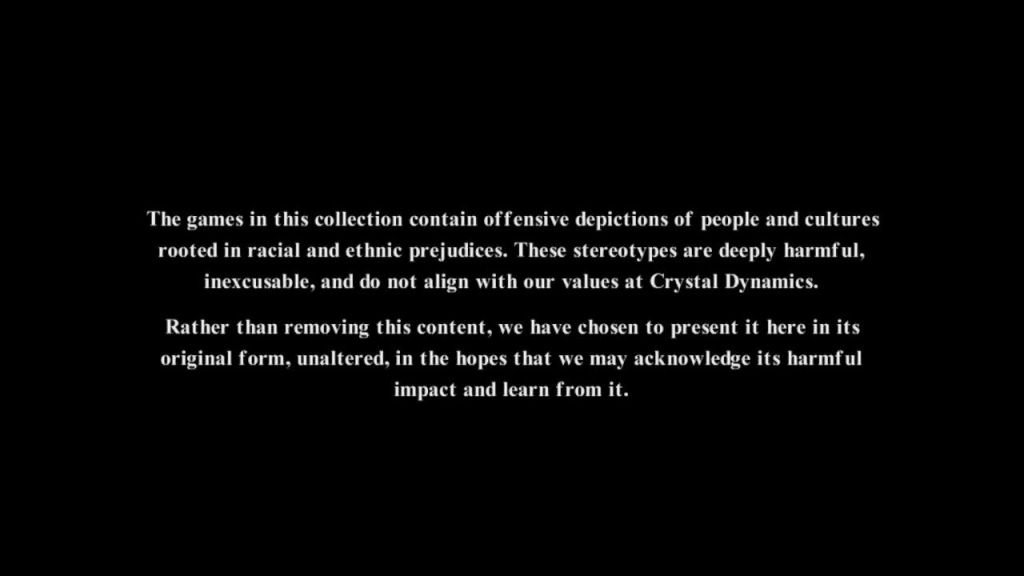
“The games in this collection contain offensive depictions of people and cultures rooted in racial and et hnic prejudices. These stereotypes are deeply harmful, inexcusable, and do not align with our values at Crystal Dynamics.
Rather than removing this content, we have chosen to present it here in its original form, unaltered, in the hopes that we may acknowledge its harmful impact and learn from it.”
It’s by ways an apology and a distancing from what you’re about to experience. Crystal Dynamics, the owner of the Tomb Raider property, wants you to know this isn’t the real them. It’s on the guys who made this stuff, 30 years ago.
And to alter that work would be to, of course, corrupt the historical record. So it’s imperative that it’s retained and we all take a long hard look at it.
However the games, recreations of the first Tomb Raider games for current hardware, which can be explored either with the original graphics or with a modern upscaled and re-lit twist, are not the original games.
These are alterations, definitionally. They have been recreated from the ground up by the developers at Aspyr with collaboration from the series’ original co-creator, and technical direction from a committed part of the Tomb Raider modding community.
The comment, obviously serves rather as a way of aligning product with market. Tomb Raider must be made again and sold again, however its developers find, as many have, including the series itself found in its wrestle to figure Lara Croft as hero, that the ambivalent neo-colonial British adventurer encountering cannibals and pillaging the sites of indigenous civilisations is actually quite a racist idea.
This is a racist text that people want to buy from you, and so you sell it back to them while shaking your head.
Funnily though, I buy it for research, to see just how racist it was (target audience according to their apology). But it’s also because I want that experience in a comfortable, handheld mode on the Switch, and I remember enjoying the games as a kid, so a nostalgia is baked in there too. A complex set of understandings and expectations underlined by an exchange, money for software. I could have just pirated but too late.
Crystal Dynamics, owned by Embracer Group, thanks you for your nostalgia money then, but does not condone what you are about to play. However, it’s important that it is unmediated from its original construction, except that it totally is, because it was remade and its textures altered and it controls differently.
Therefore it’s a remediation of the original text into one that looks more like games you’re used to and plays more like them, unless you want it to look like how it looked back when it was racist, which it still is, but it looks better. And that’s arguable anyway since, in my opinion, the upscaling and lighting looks pretty bad.
It’s a statement that is well intentioned and carries an admission that the developers may have had a tough time working on something that did not align with their beliefs about the world in order to get themselves and their bosses paid. Other remastered collections, like Crash Bandicoot and Spyro, don’t even get so far as making the admission that they are racist games. Indeed, I wonder if any of the other nostalgia collections of adventure platformers of the 90s-00s, that were somehow always racist, make this admission.
And yet, ultimately, money provides power in a capitalist society and the profit incentive, however sad you might be about it, is what drives them to Make Tomb Raider Again. Embracer is a Swedish company, Crystal Dynamics and Aspyr are based in California and Texas in the US respectively, Nintendo, Sony and Microsoft, the platform owners are in Japan and California. The way that money is moving around in terms of a global product is in a way that is priveliging those based in contemporary capitalist powers, which profit from the creation of raw materials for computer parts by people in the Global South constructed out of the post-imperial division of labour, people who ultimately are still being subalterned by the desire to build new machines to run software that remediates old racist depictions.
We apologise for our racist game, that you have bought, and will play on your machines built out of the racist profit incentive. We preserve it for historical purposes. Except. We don’t. Because. We wanted to upscale. To remaster. That is, to re-master. To master again. To be master once more. We own the ability to apologise for racism and profit from it.
Pretty good magic trick.
Inspired by reading the work of Souvik Mukherjee and this piece by Mark Mushiva and Tobéchukwu Onwukeme.
 GlitchOut