Fallstruktur (2025, PC):
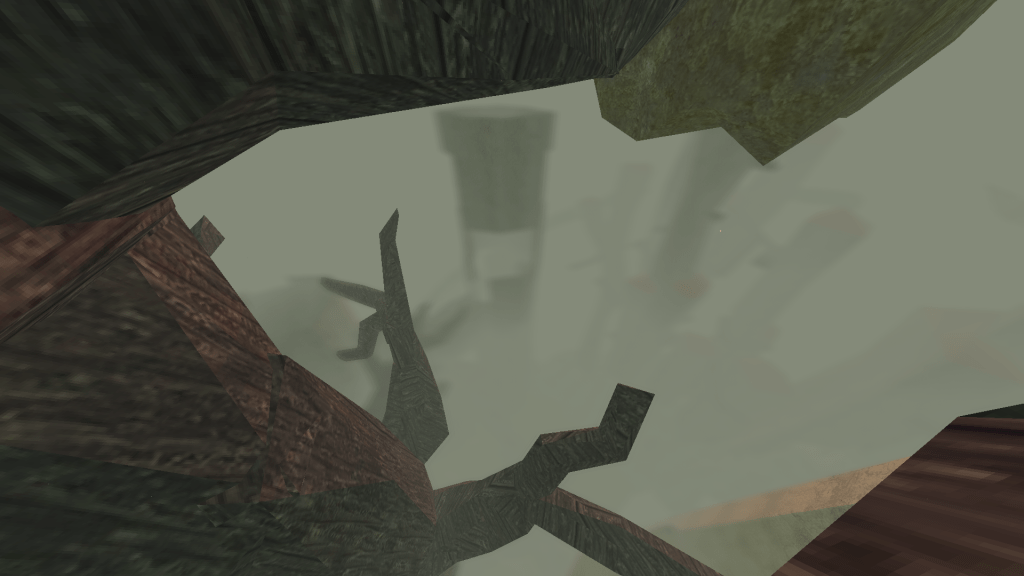
a free parkour type game from Stuffed Wombat, Fynn Levy & Rollin’ Barrel… reach the bottom without falling to your demise, across a set of paths, distinct in their shapes and texturing, tied together into a tower, a dream.
great, simple and enthralling. criss cross in and out of environmental signification, and movement strategy, tying routes together. a concrete ramp, jump between bannisters, land on a branch, on a floating mushroom. architectural forms picked out for their function slotting in to being a factor in a fall.
comes with a level editor for own struktur building.
this is a level type i explored in my own game The Entigen Trials, done better here i think. can’t remember the first time i saw a level like this, but feels it distinctly borrows obviously as an inversion of the ‘going up’ classic of platforming/climbing, but also, in its perspective, obviously that thrill of Going Down – i.e. rolling down hill, riding a bike w/o pedalling, skiing, basejumping etc… testing the limits of surface, of your own flexibility in terms of speed vs. getting hurt, rather perhaps, than the control equations of ascent, though by being in dialectic both contain each other.
going down is going up in the other direction.

…
Automaton Lung (2022, PC, Nintendo 3DS):
Luke Vincent’s action platformer also begins at the top of a tower. a building whose floors each provide a unique combination of movement aesthetics and hostile inhabitants. A collage of low-poly motifs for a lithe, gun toting protagonist to run, jump, jet boost and hoverboard around. There is no linear progression by location here, entering a door on each level takes you to a lift, a menu with the twentyodd floors available on request with no distinction.
there’s a bunch of square discs on each floor, a pretense for navigation, for working out the tricks of how far a jump might take you across various feats of beautiful, ambient 3d platforming design. environments that feel luxuriously unhurried aside from the panic brought to them by killer bugs and cubes which shoot at you (annoying).

this is a very beautiful game and i am impressed with Vincent’s obvious love for the design of concrete and plastic architecture, stretching of textures to make a point, and integration of ‘the secret’ as key.
from the top of the tower is available not just everything below in any order but the rest of the world too. my favourite part of the game being the discovery that its world extends beyond and that a capsule shaped craft takes you to an outerworld where the tower stands at the centre of a desert, ports of call in various spots dotted in the surrounding hills are other experiments in architectural form. pyramid. town. temple. etc…

…
from here let me spin out some ideas
Frederic Jameson (in Postmodernism, or the Cultural Logic of Late Capitalism – 1984, New Left Review) identified Architecture as a place where Postmodernism was most evident. i.e. what happened in the movement from a dominant Modernist, socially oriented cultural imagination under industrialisation, to, in the 60s and 70s, an emerging dominant imaginary of ‘Late Capitalism’, culture coming from and responding to the oppressively flexible form of financial privatisation of virtually every part of life, making products out of anything. Such that things that were once made to make sense, i.e. the navigation of space, now had no central locus aside from selling product.
i would in a sense argue that the platformer genre emerged as a postmodern medium designed to sell itself to you on the challenge of navigating non-social spaces. its conventions, in the coin pushing of the arcade were built on selling that experience, surviving spatial confusion.
…this idea connects with seeing game genres as ‘assemblages’, that is, a collection of ideas that form a working machine that goes on, in its influence, to be deployed repeatedly elsewhere, having effects on the people that encounter it and proliferating its diagram, which Cameron Kunzelman writes about… (How We Deal With Dark Souls, in Hydbrid Play, 2020)
here then, in Fallstruktur and Automaton Lung’s dream logic architectures, two modes of addressing this. One a collectivised tool for the production of further digital simulations of the types of navigation that haunt and thrill. One a loose narrative world, supporting in its sale the livelihood of one developer and any Megacorporations or platforms that take tax on the sale, built around the aesthetic pleasures in the control of space for the arcane collection of credits.
The tower in the centre of Automaton Lung reminds me of the Megastructures of the Metabolist movement, a small collection of architects in the 1950s-70s in Japan, whose designs were centred on a total restructuring of society around the functions of architecture. A belief, generally, in modular buildings, in legible central structures, like the lift shaft, that connected to capsules, and of a technocratic reliance on the designer.
In an excellent history of the movement, Zhongjie Lin (Kenzo Tange and the Metabolist Movement – 2010) identifies a moment that the modernist ideals of the collective gave in to the demands (and resources) of global capital, as the Japan World Exposition in 1970. The group, in taking control of the show’s design, and in pushing out one of the more leftwing architects also elected to the job, proceeded to produce a series of characteristically beautiful and strange structures, but without the social cause embedded in them before, on behalf of the financial and business interests in their work, on display to the visiting world.
The Megastructures of their dreams then fused with those of the culture’s acceleration towards profit, a thing that would mark and haunt genre fiction, in the postmodern science fiction of Manga and Anime in the 70s and 80s for instance, for which the theoretical designs of the Metabolists, and the actual upward expansions of Japanese cities based on capital, were integrated into a recurring thematics of the megastructural maze.

This is an example of where a work like Automaton Lung is a few steps down the line, the central lift of the megastructure, a fundamentally social technology, around which has grown the unique platform puzzle, a building that lives in a blasted landscape surrounded by examples of social architectures past that themselves are now theme parks for jumping.
…
both of these games i enjoyed a lot, and the richness of Automaton Lung has made it one of my favourites of all time. there are many threads to be pulled here in why platformers may be one way or another, i think.

